Epigraph

"[P]oetry makes nothing happen: it survives, / [...] a way of happening, a mouth." -W. H. Auden

Sunday, May 22, 2011

Reading John Wood and Thinking of Harold Camping

Pieter Pourbus, 1551

Yesterday, as the hour — time zone by time zone — of Harold Camping's prediction that the rapture would occur passed, I began to feel great pity for Camping. I imagine that the failure of his delusion must be utterly devastating. His "prophecy" and preaching has done great harm to many (incredibly) credulous people, but I think it cannot have been a malicious act on his part, but a sincere attempt to live up to a delusion that he firmly believed. Here is a fascinating brief view into this man and his family's life from an article on the Los Angeles Times website, with a quote from Camping's daughter, Sue Espinoza:
On Saturday morning, Espinoza, 60, received a phone call from her father, Harold Camping, the 89-year-old Oakland preacher who has spent some $100 million — and countless hours on his radio and TV show — announcing May 21 as Judgment Day. "He just said, 'I'm a little bewildered that it didn't happen, but it's still May 21 [in the United States],'" Espinoza said, standing in the doorway of her Alameda home. "It's going to be May 21 from now until midnight." 
"I'm a little bewildered," we hear the 89-year-old, who has apparently staked all of his life's energies and hopes on this one day, say to his daughter at the failure of his prophecy. It is utterly sad.


Thinking about these things, I was reminded of a long poem by John Wood about the Hoadeites, a mid-nineteenth-century religious community that believed Jesus would return in 1857. Here is one section (from Wood's Selected Poems):


from "The Gates of the Elect Kingdom"*
by John Wood


XVI: Waiting for Jesus


They waited from New Year's to Year's End
as expectation and disappointment rose to fill each day,
rose like the ripe sweet stench of silage
that hovered over the farm all summer.
Most thought it would be New Year's;
then that it would be Easter; and then, and then,
and on and on till finally at last on the Year's Eve
at midnight's wide eye's twinkling, they knew
in that sparkled turning He would descend
star-like upon the fields with light falling about Him
and night turning morning, and years and time all falling away
as clocks and calendars began again at noon in the year One.
And so they prepared the greatest feast they'd ever set:
pieces of comb were broken from the hive
heavy with honey and big as hands;
pigs were roasted and glazed rosy
with the jam of sweet plums from last canning;
and hot cabbage in wide wooden bowls
was shredded and sweetened and studded with caraway;
and jars of peaches, pickled and smelling of clove
and cinnamon stick, were opened and set out;
and the long table looked as it never had looked.
And the sisters went about their work
asking the questions they'd asked all year:
"What will you say to Him?" "What will you do
if He looks at you?" "What if He touches your hand
when you set His plate before Him?" And they worried,
"Will I be able to say, 'More cabbage, Lord? More pork?
Some cider for your cup?" And the men rehearsed their lines, as well:
"We've waited a long time, Lord; thank You for coming."
"Do You plan to shift the seasons, turn winter back,
to begin the planting now?" "Do You need a dray, Lord,
or will Your plow furrow through fields at Your touch?"
And "Forgive us our stupid questions, but this is so now, Lord;
we don't know how it is to work with You, or if we even need to speak."
But by six in the morning discontent and anger had set in,
the pork was cold and covered with a caul of grease,
the women had fallend asleep round the long table,
and von Tungeln, one of the original twelve,
said he'd had his doubts, that Hoade was false,
and he and his were heading westward. And rage broke out
like a fire in the corn and faces were dark as bruises
and others said they'd go with von Tungeln
or would just go. And they did and the end began,
and all Winkler's words couldn't stop it:
"Even prophets can misfigure,
but the Vision's still true.
Christ's still coming.
Why leave; life's good here."
But Winkler had no voice for prophecy
or magic and could hold few for long--
and finally none but his own, and they worked
what acres they could and still believed,
still waited, still sometimes picked up
the bright, sweet scent of vanilla on the air.

*Reproduced by permission of the author from Selected Poems: 1968-1998 (The University of Arkansas Press, 1999)

Wednesday, April 27, 2011

Featured Artist: Bruce Bond

Caravaggio's Narcissus, which graces the cover of Bruce Bond's book, The Throats of Narcissus.
Bruce Bond's poem, "Jon Faddis and the High Note," was awarded second prize in the first annual Asheville Poetry Review William Matthews Prize, selected by judge Sebastian Matthews from a stellar group of finalists, and will appear in the 2011 issue of Asheville Poetry Review. Bond will be participating in a reading along with the 1st- and 3rd-place winners (Michael White and Mary Makofske, respectively) at Asheville Wordfest on Saturday, May 7th at 4:00 at the YMI Cultural Center in Asheville. In anticipation of that reading, I have asked Bond's permission to reproduce "Echolalia," an amazing poem from his book The Throats of Narcissus, here. 

Bond's mastery of metaphor and phrase is ubiquitously evident, as, for example, when he compares the sound of a spoken phrase, though it be a question, to "the wraith of answers," which is in turn compared to "the bucket returning with air from the bottom." This poem is a powerful exploration of the ways we somehow find comfort within the comfortless reality of mortality--it should be impossible, but nevertheless it happens--and Bond's poem is one such impossible source of comfort for me.

Echolalia*
by Bruce Bond

Late in the day's contagion
of patients, my mind consumed
in my body's problems, my difficult heart,
I see a girl on the waiting-room carpet
crouched in her invisible house.
She is fitting a red plastic hammer in the hole
a doll's head should be,

pounding a nonexistent nail
into the eye of her shoe,
and to my own quiet surprise I ask
What's wrong?   What's wrong,
she says, word for word in a colder music,
as if speaking were her way
of listening, of passing my question on.

I'm not the only one between us
lost in translation, unlocking the voice
inside the voice, each voice a doll
split from another doll's belly;
whatever I say is her tongue's gospel;
she would make herself small for me.
And since she's not my child,

I'm bound to ask again, compelled
like the lonely confessor on a bus. 
We could be talking to our own bodies
our stunned pulse, a frozen hand
waiting for replies in pins of feeling.
Heaven knows what lies there
coiled in her ear, breaking my English

down into an ever quieter English,
if what she hears is a query
descending, a little drier on her lips,
or the wraith of answers, released:
the bucket returning with air from the bottom.
It reminds me of the malice of children,
how they mimic one another into madness,

though I know better. That night I catch
my breath in the stairwell.
With every step a fading stutter of feet.
It's a story so foreign I feel mine
pale where hers begins, with a doll
whose head pounds the daylights
into the cold bright nail of sleep

what's wrong, what's wrong, what's wrong.
I too want a way out, to make a person
of my problems and so survive them,
my heart stronger, clearer. I want to unlock
the hole in her throat with my words in it,
and I keep going there, stair after stair,
a stranger's breath on my own tongue.


*Reproduced from The Throats of Narcissus (University of Arkansas Press, 2001) by permission of the author.

Friday, April 22, 2011

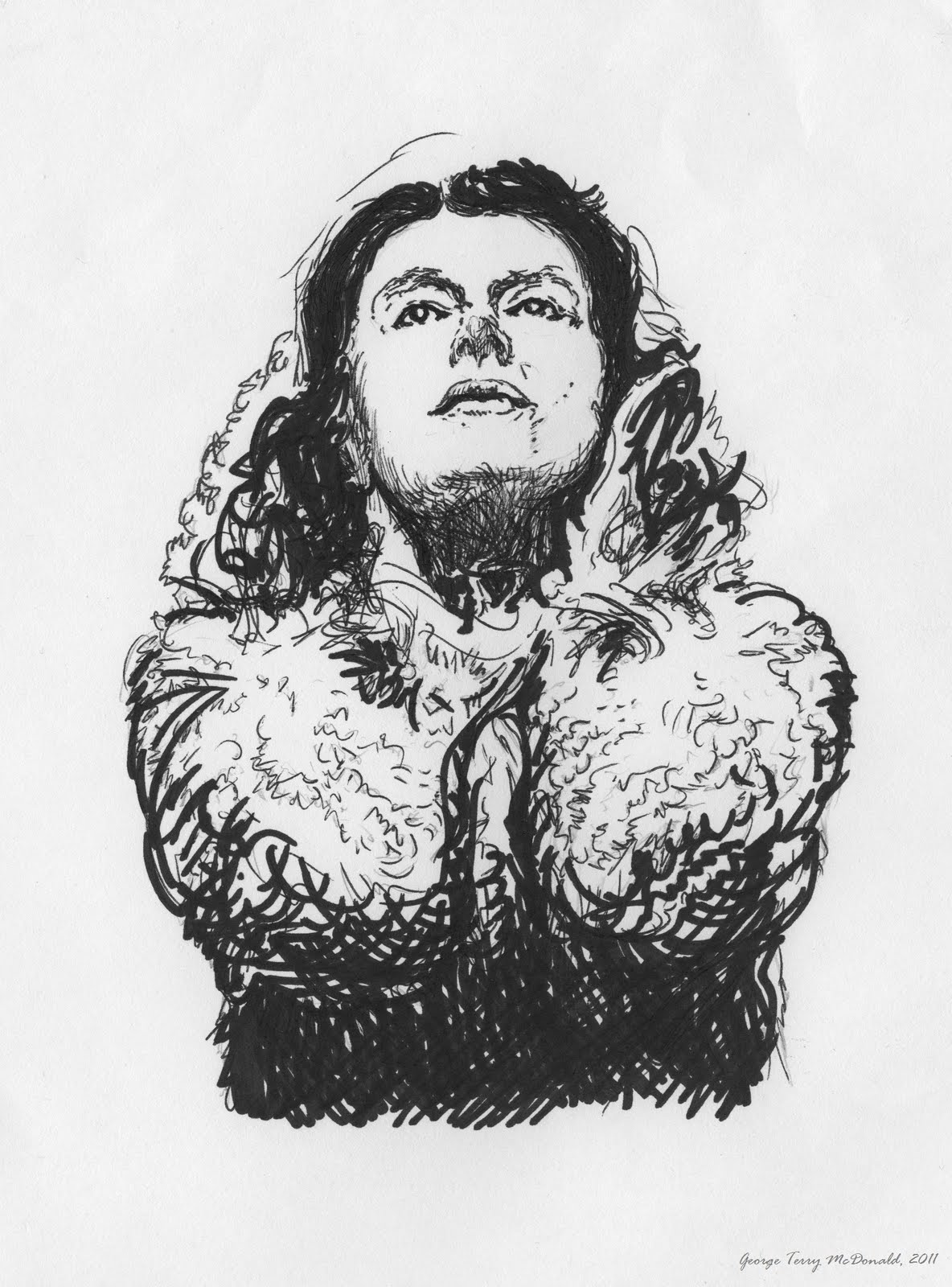
Portraits by George Terry McDonald

Here is a very cool flyer featuring artwork by George Terry McDonald for the translation event I'll be participating in at Asheville Wordfest on May 6th. (More details here and here.) I've included a few of the portraits in original size below the flyer.


Friday, April 15, 2011

Heart Found for Dean Young

A heart has been found for poet Dean Young, who has been awaiting a donor, and he was in surgery today. It sounds like things have gone well so far: http://isak.typepad.com/isak/2011/04/breaking-a-heart-for-dean-young.html

Thursday, April 7, 2011

Featured Artist: William Pitt Root

William Pitt Root was one of the featured poets at the First Annual Asheville Poetry Review Reading Series (along with Marilyn Kallet and Pamela Uschuk), and he shared the marvelous poem below, which I have reprinted from his book White Boots: New and Selected Poems of the West with his permission. He told the audience that he saw a video of slugs mating on a television nature program and was mesmerized. This poem is the result. I have also included a video of slugs mating below the poem. It is truly incredible, and Bill's poem is a moving and fitting tribute to this wonder of nature.


Slugs Amorous in the Air
by William Pitt Root
"The spirit moves,
Yet stays:
...
A small thing,
Singing."
                -Theodore Roethke


On mucous films they glide,
gracefully monstrous:


slick misbegotten whales,
halved, cast out onto land,


shrunken, left to cross forever
the shoreless sea of earth.


Indifferent to us,
these constant voyagers


detecting in each other clues
of readiness--who knows how?


They soar like gradual
eagles up a bank of tree


out onto a dark current
of limb, then dangle


from a single length
of shared umbilicus


high in clear blue
air, spinning


slowly in the globe
of their own motion,


two beings intent
upon each other


as only lovers are,
each laved by the liquid other


in bodylength embrace.
Like darkly pairing tongues


or the sundered halves
of Leviathan


trying bright reunion
in the sea of air,


they hang in that whole kiss
while we look on


radiant with disgust and envious,
pitching toward awe


as from each head
organs emerge unfurling


like silk parachutes
exquisite with awareness,


each coddling its exact
other in the counterfeit


with a long careful touching,
numinous as saint,


unutterably lewd
as they merge


in a bright soft lock
joined as orchids


might join if animated
by desire, trembling


blossom against blossom,
slow pulse


matching slow pulse
as these doubly sexed


beings will do,
continuing an hour


and more,
each gross shape further


extending (from the chill
of what should be


its head) the lucent
figure of an organ


wholly sexual as angels,
male and female brilliance twinned.


And what passes
between them


in this urgent healing
sought by the never whole


passes slow as nectar
shining in the deepest


flower we know
and multiplies


into these glistening miracles
we who grow gardens


in our annoyance
never guess.


*Reprinted from White Boots: New and Selected Poems of the West (Carolina Wren Press, 2006) by permission of the author.


Monday, April 4, 2011

A Xylophone Played by Gravity and a Wooden Ball

This is the kind of thing that is possible when people are devoted to beauty: